The Undervalued Block: How Shifting Demographics and Remote Work Are Creating New Real Estate Frontiers
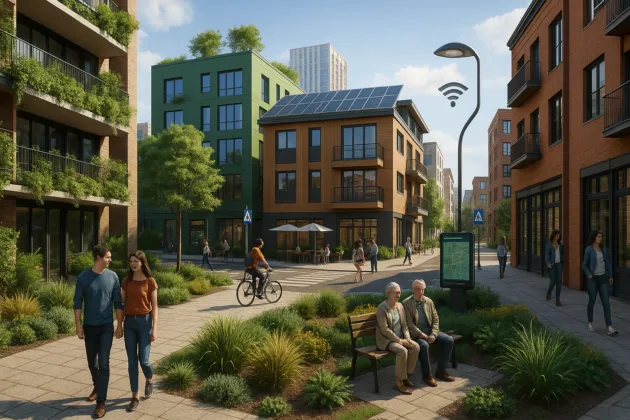
Photo: emerging neighborhood urban street transformation investment new development, via www.theworldorbust.com
For most of the past century, the hierarchy of American real estate desirability was relatively legible. Proximity to major employment centers determined land value. Coastal metros commanded premiums. Certain zip codes within those metros carried generational prestige. Investors and homebuyers navigated within that framework, competing fiercely for assets in established high-demand corridors while largely ignoring everything outside them.
That framework is fracturing. And for investors willing to read the new signals carefully, the fracture is revealing opportunity at a scale that established markets rarely offer.
What Changed — and Why It Matters Now
The pandemic years accelerated several converging trends that had been building gradually for a decade. Remote and hybrid work arrangements decoupled residential location from office geography for a substantial segment of the American workforce. The U.S. Bureau of Labor Statistics has documented persistent growth in remote-eligible employment even as headline return-to-office mandates have generated news coverage. For millions of households, the question is no longer where they must live — it is where they want to live.
Simultaneously, demographic migration patterns have shifted meaningfully. Millennial buyers, now the largest cohort in the homebuying market, have been priced out of the coastal cities where many began their careers. Gen Z buyers are entering the market with different geographic assumptions entirely, shaped by digital community rather than physical proximity. And a significant segment of aging Baby Boomers are executing long-planned relocations to lower-cost, lower-density environments — bringing equity from appreciated coastal properties and redeploying it in markets where it stretches considerably further.
The result is a redistribution of residential demand that is still playing out. Neighborhoods and cities that were overlooked for decades are receiving genuine attention — not speculative attention, but the sustained interest of households and investors making long-term commitments.
The Anatomy of a Neighborhood on the Cusp
Identifying a neighborhood before it reaches peak valuation requires looking past current prices and toward the indicators that precede price appreciation. Experienced investors have long used a loose framework sometimes called the "coffee shop index" — the appearance of independent cafes and restaurants signals that young, educated residents with discretionary income are moving in, which tends to precede broader gentrification. That framework retains some validity, but the modern version is considerably more nuanced.
Infrastructure investment signals: When municipal governments or state transportation authorities commit capital to a neighborhood — new transit lines, road improvements, broadband expansion, or park development — they are signaling a long-term bet on that area's viability. These investments typically precede private-market appreciation by three to seven years, offering a window for acquisition before prices reflect the improvement.
Anchor institution activity: The expansion of a hospital system, university, or major employer into or near a neighborhood reliably generates residential demand. Employees at these institutions need housing within reasonable distance. Tracking institutional real estate decisions and hiring announcements can provide early signals that residential demand is building.
Small business permit activity: Local planning department data on new business permits — particularly food service, retail, and personal services — provides a ground-level view of entrepreneurial confidence in a neighborhood. Rising permit activity in a previously quiet corridor often indicates that operators are betting on incoming foot traffic and residential density.
Days on market and list-to-sale ratios: As a neighborhood begins to attract interest, these metrics tighten before prices rise dramatically. A market where homes are selling at or above list price within two weeks is already competitive. The opportunity lies in identifying neighborhoods where days on market are beginning to compress but prices have not yet responded.
Secondary and Tertiary Markets: Where the Thesis Is Playing Out
Across the United States, specific categories of markets are demonstrating the dynamics described above with particular clarity.
Mid-sized cities in the Sun Belt and Mountain West — markets like Huntsville, Alabama; Boise, Idaho; and Greenville, South Carolina — have received considerable attention over the past several years as beneficiaries of migration from higher-cost metros. But the leading edge of that trend is now moving into smaller cities and even large towns that offer similar lifestyle characteristics at a further discount. Investors who missed the first wave in Boise are now examining communities in adjacent regions.
Rust Belt cities with strong institutional anchors — Pittsburgh, Cleveland, and Buffalo, among others — present a different but equally compelling case. Decades of population loss have created significant housing stock at low price points. Where institutional investment in healthcare, technology, and education is generating employment growth, the supply-demand imbalance that depressed prices for years is beginning to correct. Cap rates in these markets remain attractive relative to coastal alternatives.
Inner-ring suburbs of major metros are also experiencing revaluation. As urban cores have appreciated beyond reach for many buyers, neighborhoods immediately adjacent to city limits — historically stigmatized by their in-between status — are attracting buyers who want urban proximity without urban pricing. In markets like Chicago, Philadelphia, and Baltimore, specific inner-ring communities are undergoing rapid transformation driven precisely by this dynamic.
The Risks Are Real and Should Not Be Minimized
The potential rewards of early-stage neighborhood investment are substantial. So are the risks, and any honest analysis must address them directly.
Gentrification timelines are notoriously difficult to predict. A neighborhood that appears poised for transformation may stall for years due to factors that are difficult to anticipate: a major employer's departure, a shift in municipal priorities, or simply the absence of the critical mass of investment needed to sustain momentum. Capital tied up in a stalled market is capital that is not compounding elsewhere.
There are also meaningful social and ethical dimensions to neighborhood investment that deserve acknowledgment. Rapid appreciation driven by outside investment displaces long-term residents who may lack the financial resources to remain in communities they helped build. Investors operating in transitional neighborhoods bear some responsibility for considering the community impact of their activity, both as a matter of ethics and as a practical matter — communities that resist displacement through organized advocacy or policy intervention can slow or complicate the appreciation thesis.
Liquidity risk is another consideration. Emerging neighborhoods, by definition, have thin transaction volumes. Exiting a position in a market where few comparable sales exist can be challenging, particularly in a broader market downturn when buyers become more risk-averse and gravitates toward established areas.
A Disciplined Approach to Opportunity
For investors and homebuyers willing to do the analytical work, the current environment offers genuine opportunities that established markets cannot match. The key is discipline: grounding enthusiasm for a neighborhood's potential in concrete, verifiable data rather than narrative.
Visit the market in person, at different times of day and on different days of the week. Speak with local business owners, residents, and municipal officials. Review planning documents and capital budgets. Analyze migration data from sources like the U.S. Census Bureau and the IRS's Statistics of Income division, which tracks income migration between counties. Model multiple scenarios — not just the optimistic one.
The overlooked block that becomes tomorrow's desirable address rarely announces itself. It reveals itself, gradually, to those who are paying close enough attention to see the early signals before they become consensus.
At House & Howell, we believe that building your future in real estate sometimes means looking where others are not yet looking — and looking rigorously.